
Copper Hummingbird Weathervane on a Scottish Highland Turret
Some installations stop the conversation entirely. This customer photograph, taken at a Scottish highland cottage with a mountain valley stretching into the distance behind it, is one of those. A copper hummingbird weathervane crowns a hand built stone turret, its decorative assembly of stylised lily forms and outstretched wings catching the light above a slate roof thick with lichen and moss. The landscape behind is breathtaking in the truest sense of the word. In this article we explore the installation, the product, the character of the property, and why a copper hummingbird weathervane makes such a considered and lasting choice for rural cottages, highland properties, and anyone with a genuine love of the natural world.
A Hummingbird Weathervane on a Highland Stone Turret
The property in this photograph is everything you might hope a Scottish highland cottage to be. Rough hewn grey and brown stonework, a slate roof carrying the patina of decades of weather, a turret rising from the roofline with the kind of unhurried solidity that only genuinely old masonry possesses. The valley behind sweeps away through rolling green hills dotted with scattered farmhouses and trees, a winding river catching the light on the valley floor, and beyond that a range of rugged mountain peaks sharp against a clear blue sky. At the apex of the stone turret, the copper hummingbird weathervane sits with quiet authority. The decorative assembly incorporates stylised lily bud forms rising from the cardinal point ring, with the hummingbird figure at the very top, wings spread wide as though suspended in the moment of feeding. The copper tone of the figure contrasts beautifully with the grey stone and weathered slate below it, drawing the eye upward and giving the turret a focal point that the architecture itself invites. This is a weathervane in exactly the right setting. It does not fight the building or impose on the landscape. It completes the picture, a small but perfectly judged detail that says as much about the owners as it does about the property.
The Hummingbird Design: Detail, Movement and Meaning
The hummingbird is one of the most extraordinary birds in the natural world, and it makes for one of the most distinctive weathervane figures we supply. Hummingbirds are among the smallest migratory birds on the planet, and their name comes from the characteristic hum produced by their wings beating at remarkable speed. They are the only bird species capable of sustained hovering flight and the only birds that can fly backwards, which gives the hummingbird a unique relationship with wind and air movement that makes it a particularly apt choice as a weathervane figure. Our medium copper hummingbird weathervane captures the bird in the characteristic feeding pose, its beak extended toward a flower, wings outstretched in that suspended, hovering posture. The detail in the figure rewards close inspection: the curvature of the wings, the elongated beak and the overall proportions are faithful to the real bird rather than being a stylised approximation. When seen against an open sky, the silhouette is immediately recognisable to anyone with an interest in birds or nature.
The decorative lily bud or stylised leaf forms visible in this installation are part of the overall weathervane assembly, rising from the cardinal point ring to frame the hummingbird figure above. This gives the whole piece a botanical quality that sits particularly well on a cottage or rural property, where gardens, hedgerows and natural planting are part of the everyday environment. The combination of bird and flower in a single decorative assembly is unusual and genuinely beautiful. For those who love the hummingbird design but want a different finish, we also supply a medium aged copper hummingbird weathervane with a warmer, deeper patina, and a hummingbird mini weathervane for smaller structures or more intimate settings.
Copper Against Stone: Why the Pairing Works
There are certain material combinations in architecture that have stood the test of time because they are simply right. Copper against stone is one of them. The warm, reddish tone of freshly polished copper and the cooler grey of rough hewn stone sit in natural counterpoint, neither competing with the other nor disappearing into it. As copper oxidises over time toward amber, brown and eventually verdigris green, the relationship with the stone deepens. The patina of copper over decades mirrors the lichen and moss that colonise stone in exactly the same period, so a copper weathervane on a stone building genuinely grows into its setting. This is why copper has been the preferred material for architectural metalwork on stone buildings for centuries. Church spires, castle fittings, finials on Scottish baronial towers and the weathervanes on rural estate buildings across the British Isles have historically been copper rather than iron or steel, precisely because copper ages in sympathy with the masonry beneath it.
For a highland cottage of the kind shown here, that relationship is especially meaningful. The copper weathervane above this turret will develop its own patina over the coming years that will make the two look as though they were always intended to be together, which is the kind of long term character no painted finish can replicate. Our full range of copper weathervanes includes designs across bird, animal, nautical, transport and traditional themes, all sharing this quality of material integrity that makes copper the natural choice for stone and heritage properties.
Turrets, Domes and Unusual Mounting Points
Most guidance on weathervane installation focuses on conventional rooftop mounting points: ridge tiles, gable ends, chimney stacks. But some of the most memorable installations we see involve less conventional structures, and a stone dome or turret is among the most rewarding of all. A turret presents a natural apex that is architecturally designed to be crowned with something. Historically, turrets on Scottish castles, fortified farmhouses and highland estate buildings carried finials, flag poles, or weathervanes as a matter of course. Reinstating that tradition on a cottage turret is not an affectation; it is a restoration of the building's intended character.
The practical considerations for turret installation are straightforward. The weathervane stem needs a secure central fixing at the apex of the dome or cone roof, typically achieved with a post bracket bolted or mortared into the stonework or set into the roof structure below the cap. The key is that the fixing point is solid and the weathervane sits truly vertical so that it rotates freely rather than binding against the stem. Our brackets and fittings section covers the range of options available, and we are happy to advise on the right choice for your specific structure. Wind exposure is rarely a problem for turret installations, which tend to project above the surrounding roofline and sit in clear, unobstructed air. This is ideal for a weathervane, which needs free wind access from all directions to rotate and indicate accurately.
A Hummingbird Weathervane as a Gift
A copper hummingbird weathervane makes an exceptional gift for anyone who loves birds, nature, or the countryside. The hummingbird carries particular meaning for those interested in wildlife and natural history, and a copper figure that can be installed as a permanent feature of a home or garden is a gift that endures rather than fades. We see hummingbird weathervanes chosen as housewarming gifts for people moving to rural properties, particularly in Scotland, Wales, and the upland areas of England where stone cottages and countryside settings make a weathervane feel entirely at home. They also make outstanding retirement gifts for those who have spent a working life in agriculture, estate management, conservation or any of the land based professions, where a connection to nature and the outdoors has been central to everyday life.
For significant birthdays, a copper hummingbird weathervane is the kind of gift that a passionate birdwatcher, wildlife gardener or nature photographer would not buy for themselves but would treasure completely. It is also a beautiful and meaningful wedding gift for couples setting up a new home in the countryside, where the hummingbird and flower assembly carries its own gentle symbolism of growth, vitality and the natural world. If you are buying as a gift and want advice on the right fitting for the recipient's property or structure, we are happy to help before you order. Details of available brackets and fittings are in our brackets and fittings section.
The Installation
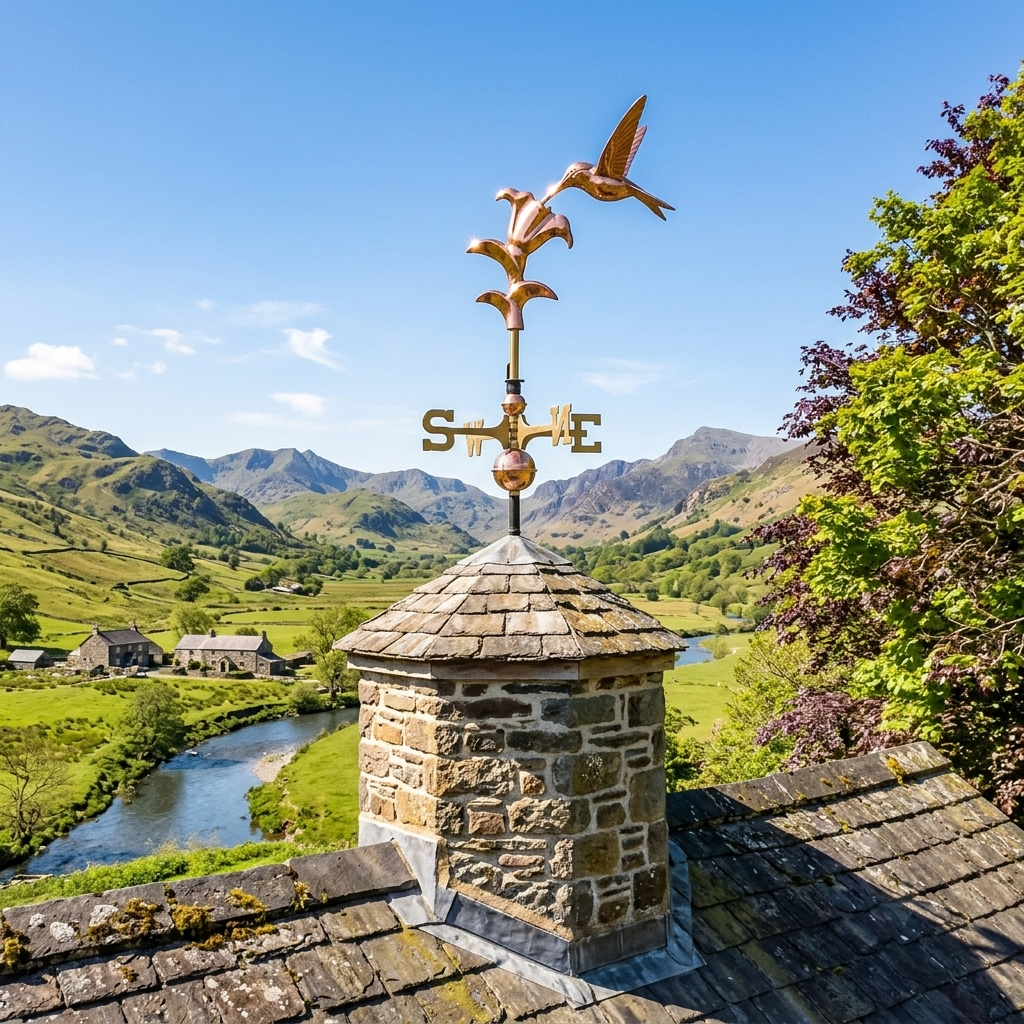
A medium copper hummingbird weathervane crowning the stone turret of a highland cottage in Scotland, with a mountain valley, river and rolling hills visible in the background.
The photograph captures the installation at its best. The copper hummingbird weathervane sits at the apex of the turret roof, its lily bud decorative assembly visible below the bird figure, the cardinal point ring and directional indicators clearly defined in copper. South and east are visible in the image, confirming the weathervane is oriented and functional rather than simply decorative. The stonework of the turret is exactly the kind of setting that makes copper look its finest: rough hewn, varied in tone, patinated with decades of Scottish weather. The slate roof below carries moss and lichen that speak to the age of the building, and the copper above will develop its own equivalent patina over the coming years. This is an installation built for generations rather than seasons. Beyond the building, the valley opens up into one of the most spectacular backdrops we have seen in a customer photograph. The mountains in the distance, the river catching the light on the valley floor, the green of the hillside and the deep foliage of the tree on the right of the frame all combine to place this weathervane firmly in the landscape rather than simply on a building. The hummingbird, wings spread at the very top, looks entirely at home.
Related Products and Useful Links
For those drawn to bird designs but looking for something different, our bird weathervanes category covers a wide range including the medium copper blue heron weathervane, the owl weathervane, and the medium copper verdigris blue heron weathervane for those who prefer an aged patina finish. The complete copper weathervanes collection brings together all available designs and sizes in polished and aged finishes.
Buying Guide: From Browsing to Installation
Choosing a weathervane for an unusual structure like a stone turret or dome starts with confirming the apex fixing point. A post bracket bolted or set into the stonework at the apex is the standard solution for turret installations. If the turret has an existing finial point, the weathervane stem may fit directly into or over it with a simple adaptor. Full details are in our brackets and fittings section. For turret installations that will be viewed from a distance across a valley or open landscape, consider whether the medium or large range better suits the scale. A weathervane that is too small will simply disappear against a highland sky. All products are delivered to UK mainland addresses in England and Wales, and we are happy to advise on fitting for stone or unusual structures before you order.
Frequently Asked Questions
Can a copper weathervane be fitted to a stone turret or dome roof?
Yes, and turrets make one of the most rewarding mounting points for a weathervane. The apex of a stone turret or dome roof provides a naturally elevated, wind exposed position that is ideal for a weathervane to rotate freely and indicate accurately. A post bracket bolted or set into the stonework at the apex is the most common fixing method for this type of structure. If you are unsure about the right fitting for your turret, contact us before ordering and we will be happy to advise.
Will a copper weathervane rust or deteriorate on a Scottish or upland property?
Copper does not rust. It oxidises naturally over time, developing a patina that moves from the original warm polished tone through amber and brown tones toward the blue green of verdigris. This process is entirely normal and is one of the most valued qualities of copper as an outdoor material, particularly on stone buildings in exposed upland locations. The patina that develops over years of Scottish weather will complement the lichen and moss on the stonework rather than contrasting with it.
What makes the hummingbird a good choice as a weathervane design?
The hummingbird is one of the most distinctive and meaningful bird designs available as a weathervane. Hummingbirds are extraordinary in nature, being the only bird capable of sustained hovering and the only species that can fly backwards, which gives the figure a particular aptness as a wind indicator. The design also pairs beautifully with the botanical decorative elements in the assembly, making it a strong choice for wildlife gardens, cottage properties, and nature lovers generally.
Is a copper hummingbird weathervane a good gift for a birdwatcher or wildlife enthusiast?
It makes an outstanding gift. A copper hummingbird weathervane is distinctive, permanent, and meaningful for anyone with a love of birds, wildlife or the countryside. It works particularly well as a retirement gift for those with a background in conservation, farming or estate management, as a housewarming gift for someone moving to a rural or countryside property, or as a significant birthday present for a passionate birdwatcher or wildlife gardener.
Do you deliver weathervanes to Scotland?
We deliver to UK mainland addresses in England and Wales. For deliveries to Scotland or other areas outside our standard delivery zone, please contact us before placing your order and we will confirm what can be arranged. All weathervanes are carefully packaged to protect the copper during transit regardless of destination.
Explore Our Copper Bird Weathervanes
If this installation has caught your eye, the medium copper hummingbird weathervane is available to browse and order directly from our online shop. Whether you are fitting to a stone turret, a chimney, a gable end or a garden structure, our team is happy to advise on design, size and bracket before you order. Explore our full bird weathervanes range or browse all designs in our complete weathervanes collection.
Featured Products


Boxing hares weathervane


Large copper arrow weathervane


Large copper banner weathervane


Large copper biplane weathervane


Large copper verdigris dolphin weathervane


Large copper verdigris stag weathervane


Large copper verdigris victorian arrow weathervane

