
Copper Victorian Arrow Weathervane on a Stone Building
The arrow is the oldest and most elemental of all weathervane designs. Before figurative silhouettes of animals or aircraft became popular, the arrow served as the universal symbol for wind direction, pointing into the prevailing wind with a clarity that needed no explanation. The Victorian arrow takes that ancient function and dresses it in the decorative language of the nineteenth century: scrolled ironwork, copper globes, and an integrated cardinal point ring that transforms a simple directional indicator into a piece of architectural metalwork. This article follows a customer installation of our medium copper Victorian arrow weathervane onto a traditional stone building, exploring why this design has endured for so long and what makes it such a natural fit for historic and rural properties.
The Victorian Arrow: Design and Heritage
Arrow weathervanes predate virtually every other design in the canon. Evidence of arrow shaped wind indicators appears on Roman buildings, and the form remained in continuous use throughout the medieval and early modern periods as the clearest way to communicate wind direction from ground level. The arrow works because it is unambiguous: the point always faces into the wind, and the aerodynamic imbalance between the slim leading edge and the broader tail keeps the assembly correctly oriented however the wind shifts. What distinguishes the Victorian arrow from its simpler predecessors is the application of decorative detail drawn from nineteenth century ornamental metalwork. Coppersmiths of the Victorian era brought an enthusiasm for scrollwork, finials, and decorative banding to everything from park railings to church gates, and the weathervane was no exception. The scrolled brackets, copper globes, and integrated cardinal points of the Victorian arrow are not mere ornament: they reflect a genuine craft tradition that gave weathervanes their place as finishing details on quality buildings. That tradition remains relevant today, with the design bridging old and new equally well on a barn conversion or a newly built stone property as it does on a genuinely historic farmhouse.
Polished Copper and What It Brings to Stone
Copper is the natural material of choice for a Victorian arrow weathervane, and not simply for reasons of tradition. As a metal it is well suited to outdoor architectural use: it does not corrode in any structurally damaging way, it develops a surface chemistry that protects the material beneath, and it has a warmth of colour that no painted steel can replicate. Against natural stone, whether dressed limestone, rough sandstone, or the harder gritstone of northern England, the contrast is vivid without being jarring. Copper reads as a material that belongs to the same craft tradition as the stonework below it: both natural, both worked by hand, both developing character over time. Over the years, an outdoor copper weathervane transitions from its initial brightness through warmer, darker amber tones as the surface oxidises. Many customers appreciate this progression: a copper piece installed for several years takes on a depth that looks genuinely embedded in the building. For those who prefer the immediate warmth of the aged patina, we also supply the medium verdigris Victorian arrow weathervane, which arrives already having progressed to the muted blue green tones of a fully aged copper surface.
A Stone Building Installation
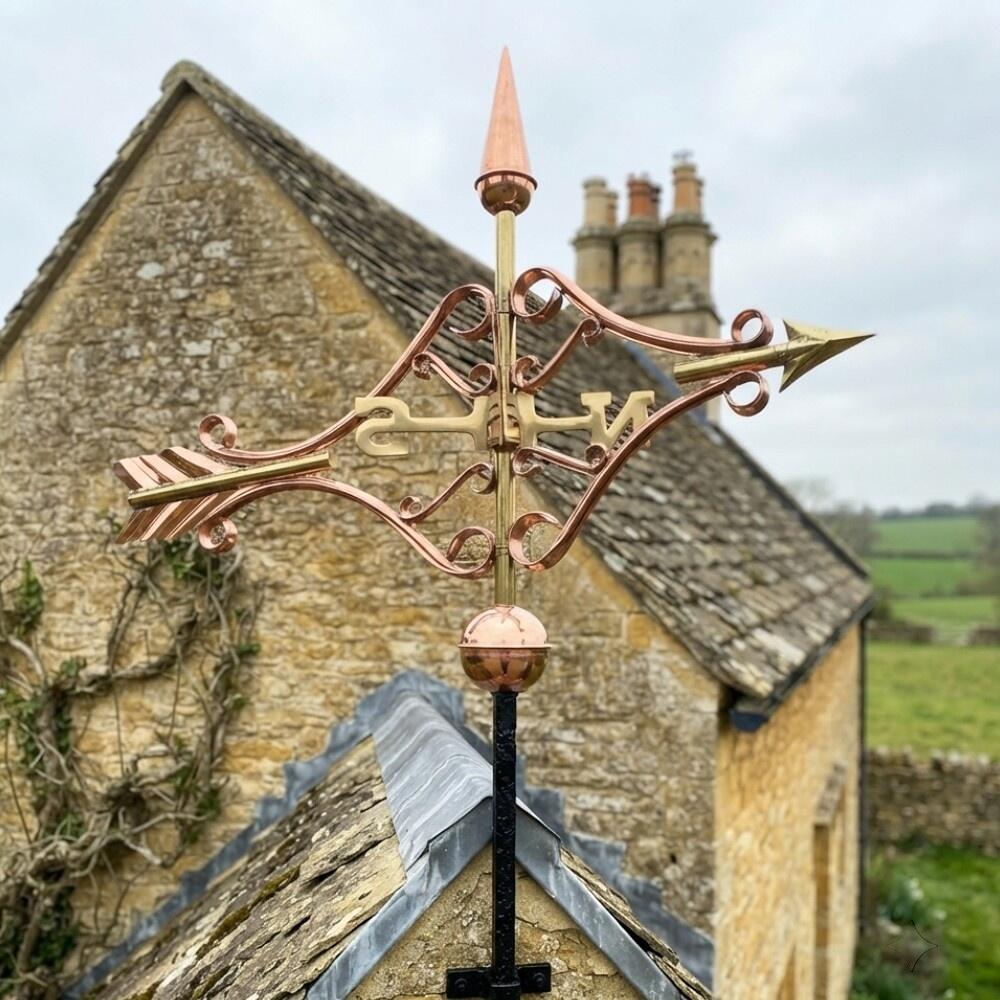
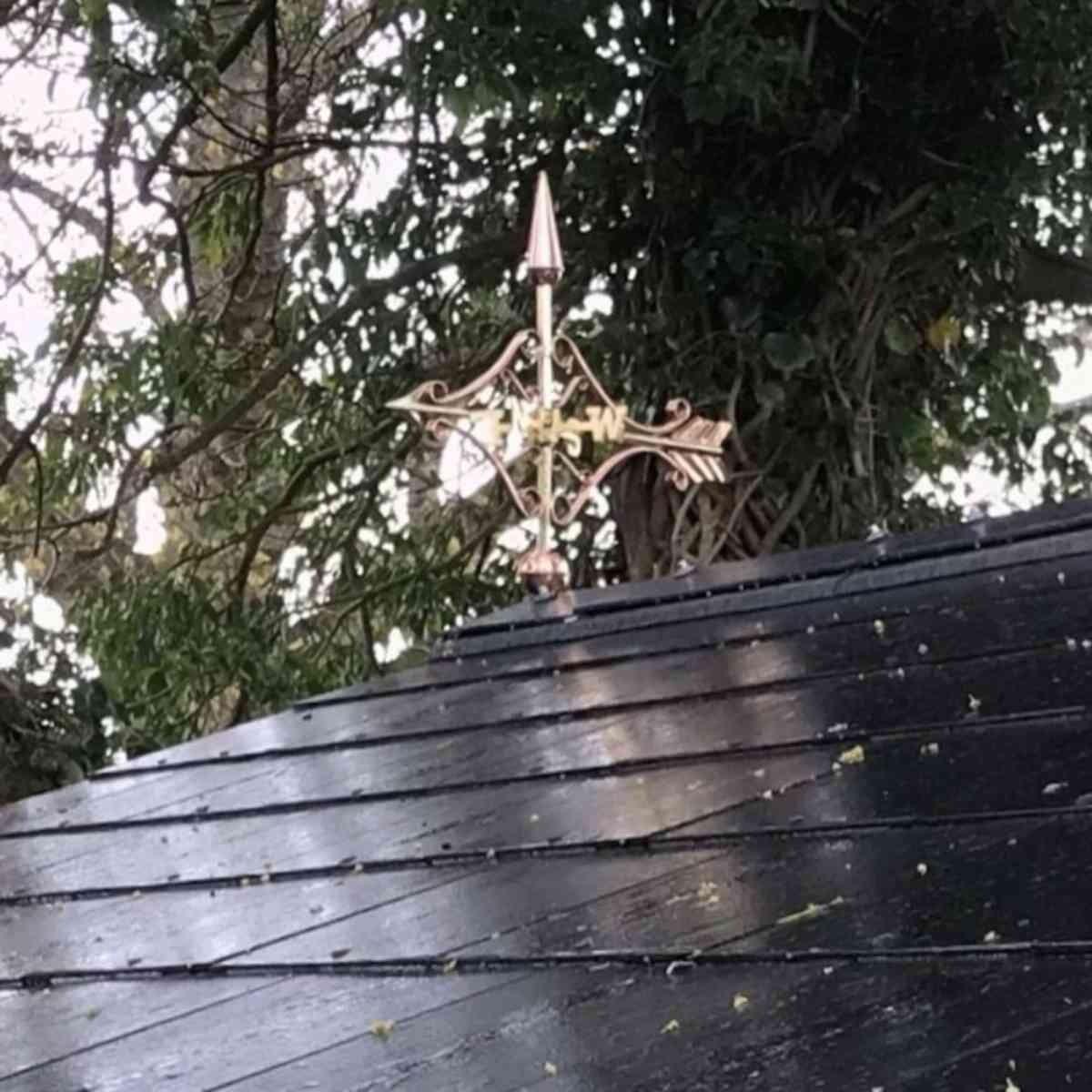
The customer photograph shows the medium copper Victorian arrow weathervane installed on a traditional stone building, positioned to take advantage of the clear skyline exposure that a property of this character typically offers. The proportions work well at this scale: the medium copper range is designed for buildings in the mid range of domestic and agricultural property, substantial enough to carry a weathervane of meaningful size without requiring an oversized piece to achieve legibility from the ground. The polished copper reads distinctly against the stone background, the warm tone creating a clear visual separation from the grey and cream of the stonework without competing with the character of the building. This is one of the reasons copper is so consistently chosen for weathervanes on traditional stone properties: it announces itself clearly while remaining within the material vocabulary of the building. The elevated installation position also ensures the vane sits above any localised turbulence caused by walls or trees, which matters practically as much as aesthetically. A weathervane that is only partially exposed to the wind will not rotate freely, and an arrow stuck pointing in one direction tells you nothing useful about the weather.
Scrollwork, Globes and Cardinal Points
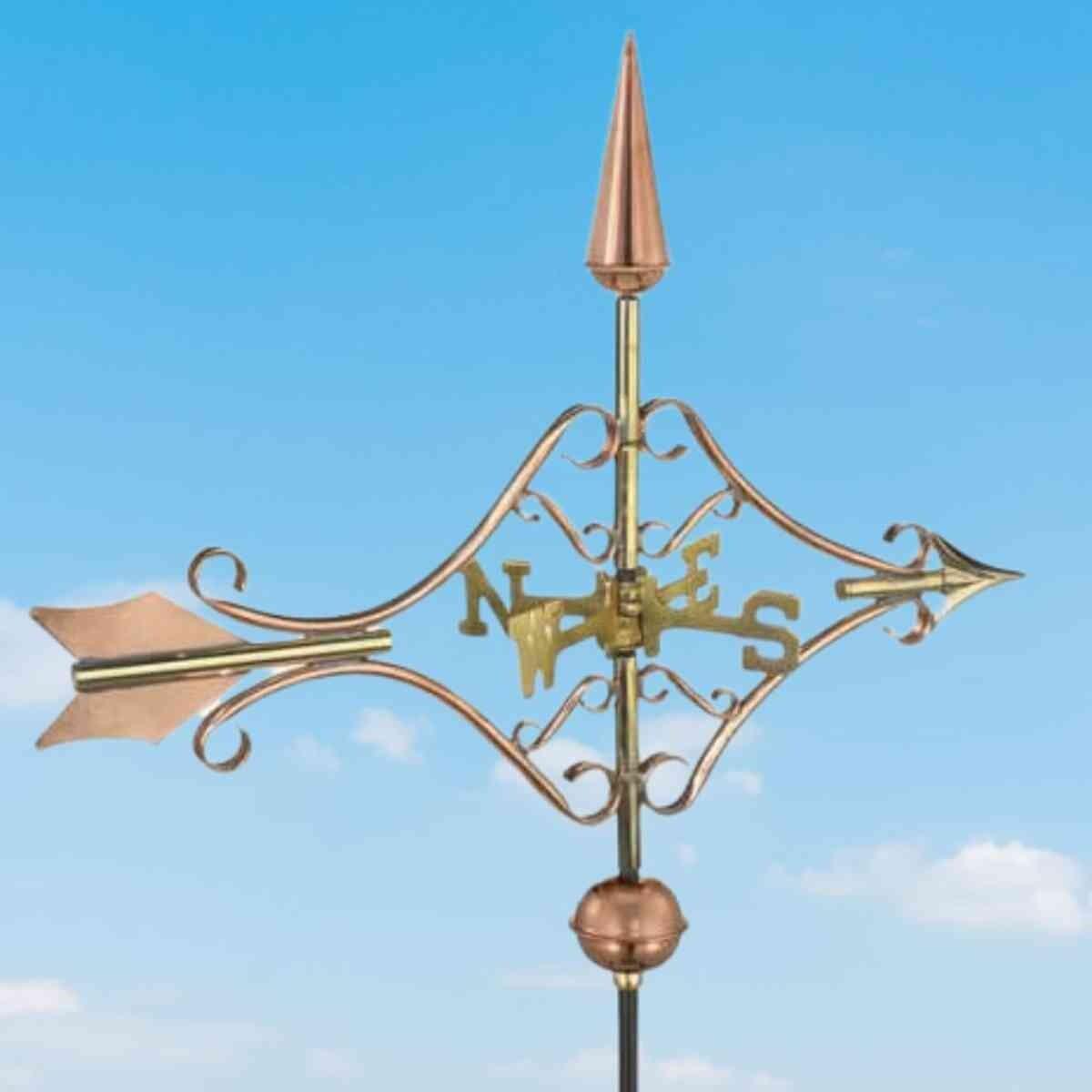
The decorative elements of the Victorian arrow are what elevate it from a simple functional instrument to a piece of architectural metalwork, and they repay closer attention. The scrolled brackets that support the arrow shaft are formed from copper bar stock, bent and shaped to produce the characteristic curving forms associated with Victorian decorative ironwork. In copper rather than painted iron or steel the effect is warmer and more refined, the material lending the scrollwork a quality that reads as precious rather than merely ornamental. The copper globes along the central stem break the vertical line with spherical accents that add visual weight at key points in the assembly, helping the whole piece read as a considered composition rather than a simple bracket with an arrow on top. Globes of this kind appear on Victorian lamp standards, finials, and railings throughout Britain, connecting the weathervane to a broader tradition of decorative metalwork that reached its high point in the nineteenth century.
The cardinal points, N, S, E and W, are integrated into the design on the Victorian arrow rather than being optional additions. On many simpler weathervane designs the cardinal point arms are a separate accessory that attaches below the pivot; on the Victorian arrow they form part of a designed unit in which the decorative elements of the scrollwork and the practical elements of direction finding are resolved together. This integration is one of the hallmarks of quality weathervane design: the piece works as a whole rather than as a collection of parts.
Mounting on Stone Walls and Gable Ends
Installing a weathervane on a stone building introduces considerations that differ from timber or rendered surfaces. Stone, particularly older dressed stonework, requires fixings that respect the material: masonry anchors or resin anchors rather than conventional screws, positioned in the mortar joints where possible to avoid drilling through dressed faces, and sized appropriately for the loads they will carry. A weathervane mounted on a stone gable end will be subject to significant cyclical wind loading over its working life, and the fixing must be capable of handling that loading without working loose or cracking the surrounding masonry.
For the medium copper Victorian arrow weathervane, the appropriate bracket from our brackets and fittings range will hold the stem assembly clear of the wall surface to allow the arrow to rotate freely. The distance from the wall is important: the full span of the cardinal point arms plus a margin for the tail of the arrow needs to clear the wall surface without the vane catching during rotation. On a stone building with any projecting courses or quoins near the installation point, this clearance distance may need to be greater than it would on a flush rendered surface. For older or listed stonework we recommend involving a builder or mason who understands the material, as repointing after the fixing is placed is simpler when the right approach has been used from the outset. A correctly installed Victorian arrow weathervane on a stone building will remain in working order for decades with no maintenance beyond an occasional check that the pivot moves freely.
A Lasting Gift for Any Occasion
The Victorian arrow weathervane is one of the most versatile gifting choices in our range because its appeal is so broad. Unlike figurative designs that carry specific associations with a hobby or animal, the arrow is universal: it suits any property and any occasion. What it carries instead is a sense of permanence and quality that makes it feel like a genuinely significant gift rather than a decorative accessory.
For a housewarming, particularly for someone moving to a stone farmhouse, barn conversion, or rural property, a copper Victorian arrow weathervane is a piece that immediately becomes part of the character of the building. For a retirement gift, it speaks of the kind of lasting thing that marks the end of one chapter and the beginning of another. For a significant birthday or wedding anniversary, the combination of genuine craft, natural materials, and an object that will outlast almost anything else on the property gives it a weight that more conventional gifts rarely achieve. Christmas is another occasion where a weathervane makes an unexpectedly memorable gift. The Victorian arrow arrives ready to install and requires nothing beyond a bracket and a compass bearing. We supply across UK mainland England and Wales and can deliver directly to the recipient at checkout.
Installation Gallery
Related Products and Resources
The medium verdigris Victorian arrow weathervane offers the same scrolled design in an aged copper finish. For larger properties or prominent positions, the large copper Victorian arrow weathervane and large copper verdigris Victorian arrow weathervane provide the same design at greater scale. The full traditional weathervanes range and polished copper weathervanes collection are worth browsing for further options, and our brackets and fittings section covers all mounting hardware for stone wall, gable end, and post installations.
Your Buying Journey
Start by considering the scale of your roofline or gable: the medium copper Victorian arrow suits domestic properties, barn conversions, and outbuildings at a standard domestic height. For a grander farmhouse, large barn, or exposed hilltop position where the weathervane needs to carry visual weight across a greater distance, the large copper version is the better choice. Once size is settled, choose the bracket: stone installations need a gable or wall mounted bracket that holds the stem clear of the surface; post or pole installations need a different fitting. Our brackets and fittings range covers the main scenarios. Delivery is by courier to UK mainland England and Wales, and installation is straightforward — the stem locates into the bracket collar and the cardinal point arms are oriented to compass north using a smartphone before final tightening.
Products Featured in This Article
- Medium Copper Victorian Arrow Weathervane — the product featured in the customer installation
- Medium Verdigris Victorian Arrow Weathervane — aged copper version of the same design
- Large Copper Victorian Arrow Weathervane — for larger properties and prominent positions
- Large Copper Verdigris Victorian Arrow Weathervane — large format aged copper version
- Traditional Weathervanes — full category of heritage designs
- Brackets and Fittings — mounting hardware for all installation types
Frequently Asked Questions
What makes the Victorian arrow different from a standard arrow weathervane?
The Victorian arrow weathervane takes the basic functional form of the directional arrow and adds the decorative elements associated with nineteenth century ornamental metalwork: scrolled copper brackets, copper globes along the central stem, and integrated cardinal point arms that form part of the overall designed unit. A standard arrow weathervane is typically a plain flat silhouette with separate cardinal point arms; the Victorian version resolves all of these elements into a composed piece of architectural metalwork that works as a whole. The result is a design that has both functional clarity and genuine decorative distinction.
How does polished copper change over time outdoors?
Freshly worked copper carries a warm, bright orange tone. Outdoors, exposure to oxygen and moisture causes the surface to oxidise gradually, progressing through darker amber and brown tones over the first few years before eventually developing the blue green verdigris patina seen on historic copper roofing and spire work. This process takes many years to complete and varies depending on the local environment. The changing surface does not indicate deterioration; copper oxidation is self limiting and actually protects the metal beneath. If you prefer the immediate warmth of the aged patina, we supply verdigris Victorian arrow weathervanes that have already been aged through a controlled process.
Can a Victorian arrow weathervane be installed on a stone wall?
Yes. Stone wall installations are entirely practical provided the correct fixings are used. Masonry anchors or resin anchors should be used rather than conventional screws, positioned in mortar joints where possible to avoid drilling through dressed stone faces. The bracket needs to hold the weathervane stem clear of the wall surface so the arrow can rotate without the tail catching on the stonework or any projecting courses. For older or listed buildings we recommend consulting a mason or builder before fixing, as the right approach for soft limestone or rubble stone will differ from that for harder dressed stone.
Should I choose polished copper or verdigris for a stone building?
Both finishes work well against natural stone, but they create different visual effects. Polished copper offers a warm, bright contrast against the grey and cream tones of stonework that makes the weathervane an immediate focal point. Verdigris copper offers a muted, more integrated appearance that looks as though the piece has always been part of the building. The choice largely depends on whether you want the weathervane to stand out prominently or settle into the roofline. Both are equally durable and require no maintenance beyond occasional checks that the pivot is moving freely.
Is the medium or large Victorian arrow right for my property?
The medium copper Victorian arrow is well suited to standard domestic properties, barn conversions, outbuildings, and garden structures where the roofline sits at a typical domestic height. The large version is better suited to prominent positions on grander farmhouses, large barns, or elevated sites where the weathervane needs to carry visual weight across a greater viewing distance. If you are unsure which size is right for your building, compare the listed dimensions of each design against the width and height of your intended installation point, or contact us and we can advise based on your specific situation.
Find Your Victorian Arrow Weathervane
If the stone building installation in this article has caught your eye, the medium copper Victorian arrow weathervane is available to order directly. The verdigris and large copper versions are also available, and the full traditional weathervanes range is worth exploring if you are weighing other classic designs. If you have a question about sizing, brackets, or installation on a specific building type, please get in touch and we will be happy to help.
Featured Products


Boxing hares weathervane


Large copper arrow weathervane


Large copper banner weathervane


Large copper biplane weathervane


Large copper verdigris dolphin weathervane


Large copper verdigris stag weathervane


Large copper verdigris victorian arrow weathervane

